 Join Telegram Channel
 Join WhatsApp Channel
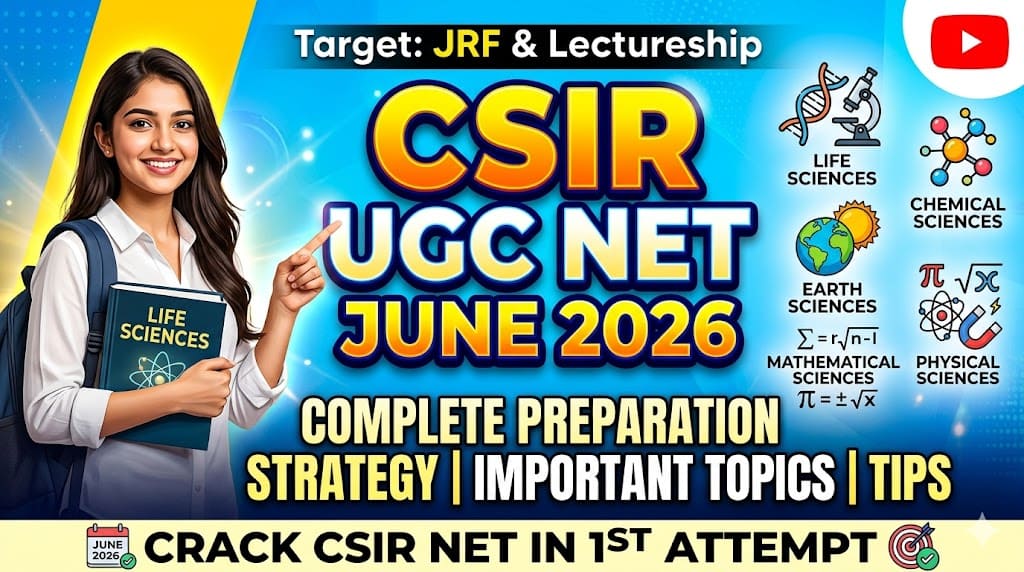
CSIR UGC NET June 2026:- National Testing Agency (MHRD, Department of Higher Education) has released a notification for Council of Scientific and Industrial Research (CSIR) University Grants Commission (UGC), National Eligibility Test (NET) June, 2026 Cycle to determine the eligibility of Indian nationals for Junior Research Fellowship (JRF) and for Lectureship (LS) /Assistant Professor in Indian Universities and Colleges in Computer Based Test (CBT) mode. Eligible candidates can apply online from 27.05.2026 to 19.06.2026 (Upto – 11:-50 P.M.) using given link below. Other details like educational qualification, age limit, selection process & how to apply are given below……..
Name of the Course:- CSIR UGC NET
Age Limit:
- For NET: There is no upper age limit
- For JRF (Max. 30 years as on 01.07.2026): Born not earlier than 02.07.1996. {A relaxation of upto 5 years is provided to the candidates belonging to OBC-NCL (as per the Central list of OBC available on website: www.ncbc.nic.in) / SC / ST / PwD / Third gender categories and to women applicants}
Qualification: M.Sc or equivalent Degree / Integrated BS-MS / BS-4 years / BE / B.Tech / B.Pharma / MBBS with at least 55% of marks. 50% of marks for SC/ST/PwD candidates. Candidates enrolled for M.Sc or having completed 10+2+3 years of the above qualifying examination as on the closing date of online submission of application form, are also eligible to apply in the above subject under the Result Awaited (RA) category on the condition that they complete the qualifying degree with requisite percentage of marks within the validity period of two years to avail the fellowship from the effective date of award (Such candidates will have to submit the attestation form duly certified by the Head of the Department/Institute from where the candidate is appearing or has appeared)
Fees: Rs. 1150/- for General candidates, Rs. 600/- for EWS / OBC candidates and Rs. 325/- for SC / ST / PwD / Third Gender candidates. Fees should be paid through Online via Debit Card / Credit Card / Net Banking / UPI.
How to Apply: Eligible and Interested candidates can apply online from 27.05.2026 to 19.06.2026 (Upto – 11:-50 P.M.) using link given below. The applicants need not to be sent their filled application form to concerned department.
- Candidates are advised to read the Official Detail carefully before applying.
- Click on the Apply Online Link given below
- Fill the Application Form Carefully
- Upload the Required Documents Online
- Pay Online / Offline Fees
- Print the Application Form / Save PDF Format.
Important Dates of CSIR UGC NET June 2026:
- Start from: 27.05.2026
- Closure Date: 19.06.2026 (Upto – 11:50 P.M)
- Last Date of Online Payment: 20.06.2026 (Upto – 11:50 P.M)
- Date of Correction in Application Form: 22.06.2026 to 23.06.2026 (Upto – 11:50 P.M)
- Date of Announcement City of Exam Centre: 08.07.2026
- Date of Examination: 17.07.2026 and 18.07.2026
- Date of Uploading Result: To Be Announced
| Click for Latest Jobs | Click here for Latest Admit Card |
| Click for Latest Result | Click here for Latest Answer Key |
- Haryana Ration Depot Online Form 2026Haryana Ration Depot Online Form 2026:- Food & Supplies Department, Haryana has released a notification for recruiting of Ration Card Depot Holder in… Read more: Haryana Ration Depot Online Form 2026
- AYUSH Society Bhiwani Recruitment 2026AYUSH Society Bhiwani Recruitment 2026:- District Ayush Society, Bhiwani has released a notification for filling up 25 posts of Specialist (Ayurvedic Spl.),… Read more: AYUSH Society Bhiwani Recruitment 2026
- AIIMS Norcet 11 Nursing Officer Stage – II Exam Result 2026AIIMS Norcet 11 Recruitment 2026:- All India Institute of Medical Sciences, Ansari Nagar, New Delhi has released a recruitment notification for filling… Read more: AIIMS Norcet 11 Nursing Officer Stage – II Exam Result 2026
- PGIMER Chandigarh Nursing Officer Exam Postponed Notice 2026PGIMER Chandigarh Nursing Officer Recruitment 2026:- Postgraduate Institute of Medical Education and Research, Chandigarh has released a recruitment notification for filling up… Read more: PGIMER Chandigarh Nursing Officer Exam Postponed Notice 2026
- UPSC NDA and NA II Exam Result 2026UPSC National Defence Academy (NDA) & Naval Academy (NA) Examination (II), 2026:- Union Public Service Commission (UPSC) has released a notification for… Read more: UPSC NDA and NA II Exam Result 2026
9 thoughts on “CSIR UGC NET June 2026 E-Certificate Link”
Small visual details often carry more personality than a longer caption, especially when space is limited. A well-organized collection of copy and paste symbols makes it easier to find marks that fit a specific mood without hunting through character tables. Grouping options by style and use case is particularly helpful for people refining bios, display names, or short social posts while keeping the text readable.
Unicode styling can make short social copy easier to scan when it is used selectively rather than turning every line into decoration. Letra Cursiva is useful for exploring italic and fancy text variants that can be copied into profile names, bios, captions, or messages. The practical consideration is readability: test the final characters in the destination app, keep important information in plain text, and reserve styled words for emphasis or a recognizable personal touch.
Readers working with equations often need more than a visual character: they need syntax that survives copying between a manuscript, a browser, and source code. A concise notation reference can reduce ambiguity by placing each relation mark in its technical contexts and explaining when it conveys approximation rather than equality. LaTeX approximately equal is a useful lookup point for authors preparing academic or technical material, while character and encoding details help developers keep the same meaning in published interfaces. That combination supports clearer communication without overloading a simple formula.
A useful conversion workflow should preserve enough structure to make the output practical, not merely extract paragraphs. With PDFtoMDConverter, text PDFs and clear English scans can be turned into editable Markdown locally in the browser, without an account or application-server upload. It still makes sense to check headings, tables, and unusual page layouts afterward, since those elements determine whether the Markdown is ready for notes, documentation, or publishing.
The detailed breakdown of the CSIR UGC NET June 2026 notification is really helpful, especially the clear timeline and eligibility criteria for JRF and lectureship. For candidates preparing for the exam or planning a career in research, keeping up with the latest developments in AI and computational tools can be a game-changer. Many of these tools are now integral to scientific research, from data analysis to literature review. I recently came across AI for science research hub, which aggregates news, tools, and information specifically for AI in science and research. It’s a great supplementary resource for anyone in academia, whether you’re aiming for JRF or just want to stay ahead in your field. Thanks for sharing this update.
This is a thorough summary of the CSIR UGC NET June 2026 notification, especially the details on the JRF age limit and the relaxation for OBC-NCL and other categories. For those preparing for the exam, it’s worth remembering that the NET also opens doors to international research collaborations. If you’re considering working with Chinese institutions, having basic Mandarin skills can be a real advantage. I’ve been using a gamified platform for immersive Chinese tone practice that makes learning tones feel like playing a game. It’s designed for all levels, so even absolute beginners can build a solid foundation without it feeling like a chore. Just a thought for anyone looking to add a competitive edge after the exam.
Thanks for sharing the detailed CSIR UGC NET June 2026 information, especially the timeline for results and scorecards. For those aiming for JRF or lectureship, this exam opens doors to research careers. Once you begin your research, you’ll quickly realize how time-consuming it is to create figures for papers. I’ve been using scientific illustration and data plotting tool that generates publication-ready diagrams, data plots, and flowcharts from simple prompts or data uploads. It even exports to SVG for fine-tuning. It’s cut my figure preparation from hours to minutes. If you’re preparing for a research career, it’s worth checking out.
The comprehensive details on CSIR UGC NET June 2026, from application dates to eligibility, are invaluable for aspirants. While the focus is rightly on exam preparation, it’s worth noting that many candidates also wonder about their future beyond the test. Palmistry, for instance, has long been used to explore personality traits and potential life paths. There’s an AI palm reader that can analyze a photo of your palm to give such insights—a lighthearted way to pass time while awaiting results. It’s not a predictor of exam outcomes, but it can be a fun conversation starter. For those intrigued, you can check out AI palm reading insights to learn more.
Good to see the June 2026 CSIR UGC NET timeline laid out so clearly, especially the gap between the 17-18 July exam dates and the result announcement, which is still marked TBA. One practical tip for anyone waiting on the score card: keep your application number, roll number and the attested Result Awaited certificate from your department handy, since JRF eligibility verification often gets delayed when those documents are missing. The weeks between CBT and result release are genuinely stressful, so I usually suggest candidates build a light routine instead of refreshing the result link every hour. I found a nice way to unwind during that stretch: free browser visual novels with no downloads or signup, each with a short hand-written review, over at free browser visual novels. It kept my mind off the score card long enough to actually rest before interviews.